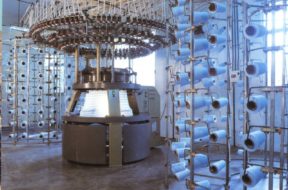
0shares Facebook Twitter LinkedIn Tumblr Digg Print Reddit Weibo Xing Blogger MySpace Knitting Knitting is the second most popular technique of fabric or garment formation by inter-looping one or one set of yarns. Continuous length of yarn is converted into vertically intermeshed loops either by hand or by machine. The most important parameter of a knitted fabric […]
Fabric Engineering
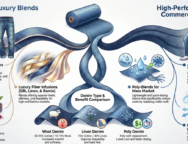
Fibers for Technical Textile
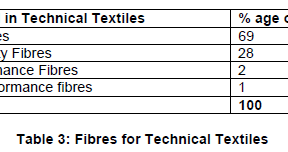
0shares Facebook Twitter LinkedIn Tumblr Digg Print Reddit Weibo Xing Blogger MySpace The usages of fibres in the technical textile area are not only the high functional fibres alone, but also the natural (due to bio-degradability and compatibility) and common man-made fibres occupied considerable share, which is shown in table . ( 1 ) Domestic […]
Management and it’s Functions
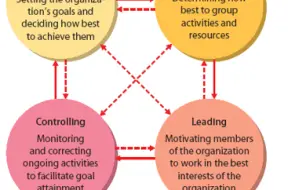
Management involves four basic activities—planning and decision making, organizing, leading, and controlling. Although there is a basic logic for describing these activities in this sequence (as indicated by the solid arrows), most managers engage in more than one activity at a time and often move back and forth between the activities in unpredictable ways (as shown by the dotted arrows).
Unevenness and Coefficient of Variation of Yarn
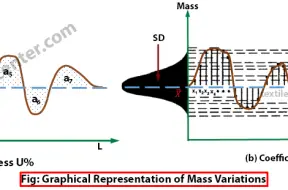
Unevenness and Coefficient of Variation of Yarn: The average value for all the deviations from the mean which is expressed as a percentage of the overall mean is called percentage of Mean Deviation (PMD). The coefficient of mass variation CV % is the ratio of standard deviation of mass variation divided by average mass variation.
Index of Irregularity
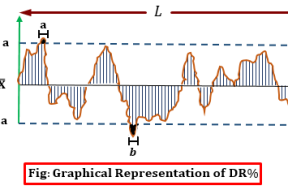
The ratio between the actual irregularity present in the material and the calculated limit irregularity is called index of irregularity. It is denoted by I. Accordingly the best yarn have a value of I = 1. Thus, the higher value of I indicate that the yarn is more irregular. On the other hand, the CV of the most regular/uniform strand of material in which the fiber ends are laid in a random order in the sliver, roving, or yarn is called limit irregularity.
Basic weft Knitting Loops
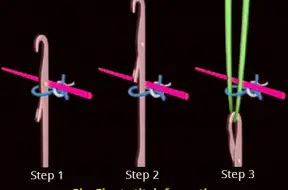
When the needle is raised sufficiently high by the camming action to obtain the yarn in the hooked portion of the needle and the old loop is below the latch [i.e, the old loop is cleared], a knit stitch will be formed as the needle descends.
Float Stitch and it’s Formation Process
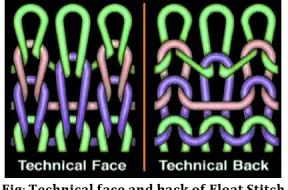
A float stitch or welt stitch is composed of a held loop, one or more float loops and knitted loops.It is produced when a needle (M) holding its old loop fails to receive the new yarn that passes, as a float loop to the back of the needle. The float stitch shows the missed yarn floating freely on the reverse side of the held loop.
Tuck Stitch and it’s Formation Process
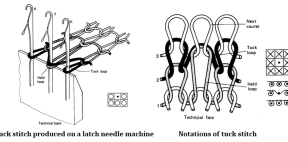
A tuck stitch is composed of a held loop, one or more tuck loops and knitted loops. It is produced when a needle holding its loop (T) also receives the new loop, which becomes a tuck loop because it is not intermeshed through the old loop. The tuck loop thus assumes an inverted V or U-shaped configuration. The head of the tuck is visible on the reverse of the stitch.The side limbs of tuck loops thus tend to show through onto the face between adjacent wales. Tuck stitch structures show a faint diagonal line effect on their surface. In analysis, a tuck stitch is identified by the fact that its head is released as a hump shape immediately the needle loop above it is withdrawn. A knitted loop would be required to be separately withdrawn
Different types of Sinkers
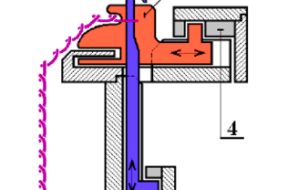
The sinker is the second primary knitting element (the needle being the first).It is a thin metal plate with an individual or a collective action operating approximately at right angles from the hook side of the needle bed, between adjacent needles.
Different types of Knitting needles
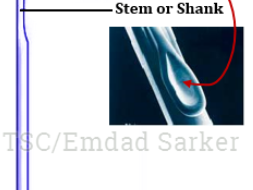
Primary knitting elements:Three primary knitting elements:
Needle: Latch needle, Spring bearded needle & Compound needle.
Cam: Knit cam, Tuck Cam, Missed cam
Sinker: Holding down sinker, Knocking over and loop forming sinker
Main parts and their functions of latch needle
The hook: Grasping a new yarn in the process of knitting i.e. the hook which draws and retain the new loop.
The latch: Freely rotating around the axle and tightly closing the hook owing to the spoon located at the end of the latch.