
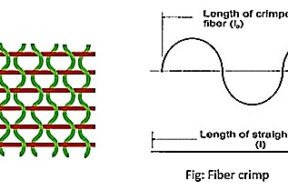
Crimp is a term to describe the waviness of a fiber. We can also describe this in terms of the force or energy required to uncrimp a fiber. It’s expressed in percentage. A crimped fiber placed on a flat plane is l0 and the length of the same fiber when the crimp is removed by applying a tension is l, then the crimp is given by …
Yarn Engineering
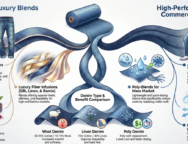
Instantaneous and time-dependent effect
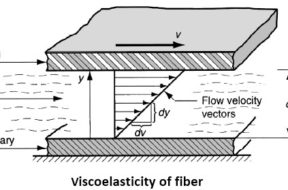
When a load is applied on a specimen constantly for a period of time, the specimen initially extends rapidly giving the instantaneous effect and then less rapidly which yields to time dependent effect.
Electron Microscope
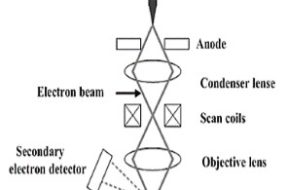
There are two different types of electron microscopes, scanning electron microscopes (SEM) and transmission electron microscopes (TEM). In the TEM method, an electron beam passes through an extremely thin section of the specimen.
X-ray diffraction method
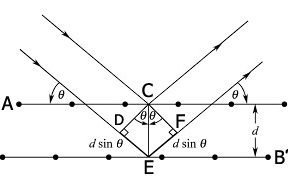
It is an independent method to determine the amount of crystalline matter present in the fiber. W. L. Bragg presented a simple explanation of the diffracted beams from a crystal. When X-ray beam is incident on a crystal, it strongly reflected wherever its layers of atoms at an angle show in fig. Such that, nλ=2dsinθ
Absorption of IR radiation method
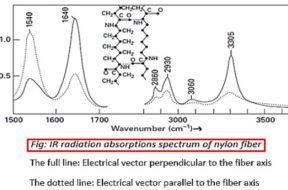
Infra-red (IR) spectroscopy is one of the most common and widely used spectroscopic techniques. When electromagnetic waves interact with matter, they are scattered and absorbed. Infrared spectroscopy, radiation with wavelengths between 1 -15 μm is absorbed at certain characteristic frequencies, which yield structural information.
Crystalline and Amorphous Structure of Fiber
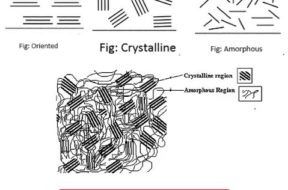
Amorphous region of the fiber is defined as the region of the fiber where there is no longer the order of chain molecules. The polymer chains are randomly placed in amorphous region. As a result, there is more air space in the amorphous fiber.
Span Length
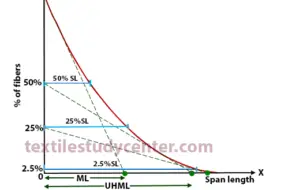
x % Span length is the distance spanned by x %of fibers in the specimen being tested when the fibers are parallelized and randomly distributed and where the initial starting point of the scanning in the test is considered 100%. This length is measured using "Digital Fibrograph‘.
Fibrograph Method
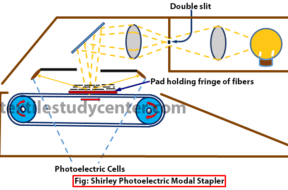
The original idea of the photoelectric scanning or Fibrograph method has been developed by Hertel in 1940 for testing cotton lint. This test method is much faster than the array method and is used widely in fiber laboratories for measuring fiber length and length distribution.
Effective Length of Cotton Fiber
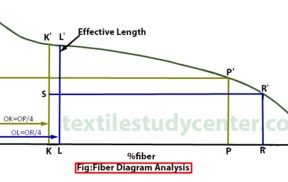
The effective length is the upper quartile of the fiber length distribution obtained by ignoring short fibers whose length is below half the effective length.
Length parameters of cotton fibers
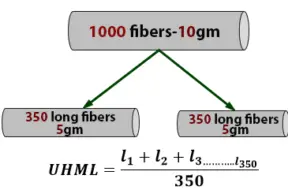
The most frequent length in a fibrous sample is called staple length. Staple length is one of the most important factors of cotton quality because both fiber fineness and fiber tensile strength are associated with staple length. The longer staples are usually finer and stronger than the shorter staples.