
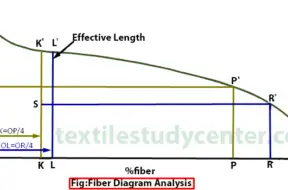
The fiber sorter is an instrument which enables the sample to be fractionalized into length groups. The Baer sorter, the Shirley comb sorter, and the Suter-Webb sorter are the most popular method of the fiber sorter. Basically, the operation involves four main steps:
Preparation of a fringe or tuft with all fibers aligned at one end.
The separation or withdrawal of fibers in order of decreasing length.
The preparation of a sorter diagram by laying the fibers on a black velvet pad in decreasing order of length, the fibers parallel and their lower ends aligned along a horizontal base line as shown in Figure.
The analysis of the sorter diagram.
Yarn Engineering

Fiber Length and Length Distribution
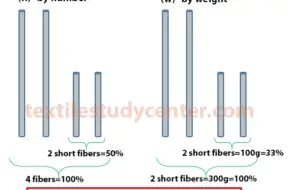
After fineness, length is the most important property of a fiber. The length of cotton is directly related to its spinning performance. Knowledge of fiber length is necessary to manufacture a yarn of specific size on ring spinning system and typically longer fibers are used to manufacture fine yarns. Longer fibers are generally more uniform, finer, and stronger than shorter ones.
Graphical Representation of Mass Variations
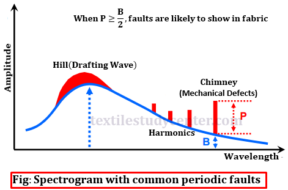
0shares Facebook Twitter LinkedIn Tumblr Digg Print Reddit Weibo Xing Blogger MySpace Graphical Representation of Mass Variations Graphical representations are aimed at providing easy analysis possibilities as well as providing more complete information than the numerical estimates. The following graphical representations are common with the latest generation evenness testers. Spectrogram 3D Spectrogram Variance Length Curve […]
Yarn Evenness II It’s Classification
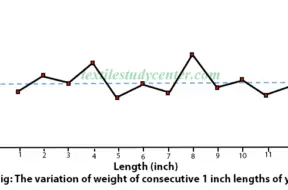
0shares Facebook Twitter LinkedIn Tumblr Digg Print Reddit Weibo Xing Blogger MySpace Yarn Evenness & It’s Classification Evenness, Unevenness, regularity, and irregularity are common terms used to describe the degree of uniformity of a textile product. In the textile field, the uniformity of products like the lap, sliver, roving or yam is expressed in terms […]
Study on four truck circular knitting machine.
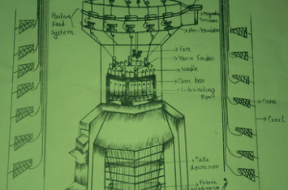
Most single-jersey fabric is produced on circular machines whose latch needle cylinder and sinker ring revolve through the stationary knitting cam systems that, together with their yarn feeders, are situated at regular intervals around the circumference of the cylinder. The yarns is supplied from cones, placed either on an integral overhead bobbin stand or on a free-standing creel, through tensioners, stop motionsand guide eyes down to the yarn feeder guides.
Methods of Evenness Testing
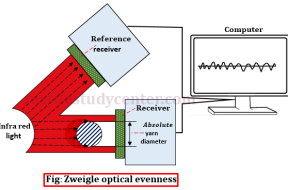
The optical method measures the variations in diameter of a yarn and not in its mass. The instrument an infra-red transmitter and two identical receivers. The yarn passes at speed through one of the beams, blocking a portion of the light to the measuring receiver. The intensity of this beam is compared with that measured by the reference receiver and from the difference in intensities a measure of yarn diameter is obtained.
Speed Frame Production Calculation
Math 1: Calculate the TPI (twist per inch) produced on a simplex with diameter of front roller 28 mm and its rpm be 30. The rpm of flyer is 1000.
Twisting and Amounts of Twist for Different Materials – why is the amount of twist in a yarn important
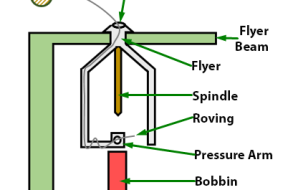
The roving coming out of the front delivery roller is threaded through the top of the flyer, passes through its hollow leg around the presser arm on to the bobbin. The purpose of providing twist in roving is to give the strand sufficient strength to withstand the strain during unwinding in the creel of the ring frame. The insertion of twist is achieved by the rotation of the flyer.
Study of Twist | Twist in yarn | Introduction of twist in yarn
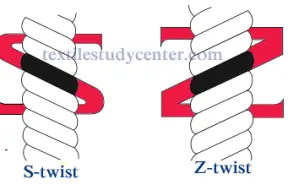
0shares Facebook Twitter LinkedIn Tumblr Digg Print Reddit Weibo Xing Blogger MySpace Study of Twist in spinning | Twist in yarn | Introduction of twist in yarn Definition of twist: The term “twist” defines the helicoidal or spiral configuration organized by the rotation of a yarn or of a bundle of fibers around their […]
Drawing, Texturing, Intermingling and Heat setting Process
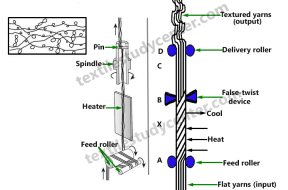
Man Made Fibre and Man Made Fibre Production - Manufactured (MF) fibers (formerly termed “man-made”) are formed from a suitable raw material as a thick, sticky liquid, which is “spun” or extruded through spinneret holes, forming streams that are solidified into fibers.