Float Stitch and it’s Formation Process


Emdad Sarker
Latest posts by Emdad Sarker (see all)
- Knitting Faults in fabric - November 17, 2017
- Basic weft Knitting Loops - March 26, 2016
- Float Stitch and it’s Formation Process - March 25, 2016
Float Stitch and it’s Formation Process
Float/Missed Stitch
Features of float stitch
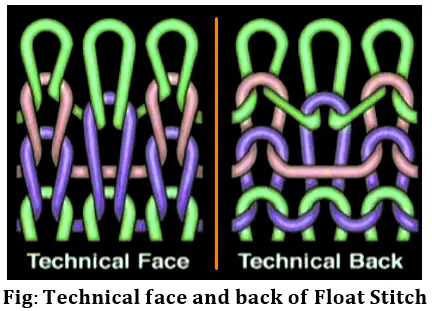
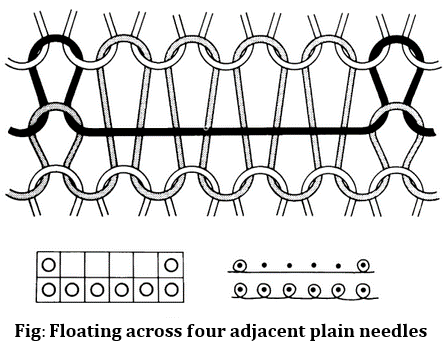
►A float stitch or welt stitch is composed of a held loop, one or more float loops and knitted loops.
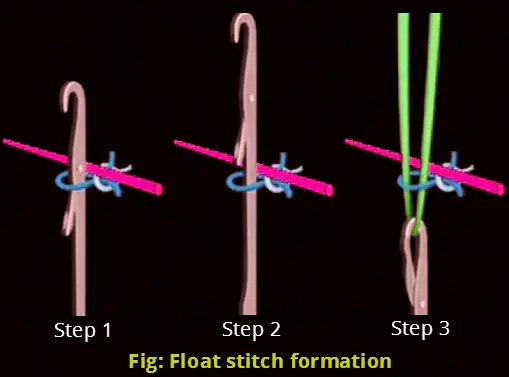
►It is produced when a needle (M) holding its old loop fails to receive the new yarn that passes, as a float loop to the back of the needle.
►The float stitch shows the missed yarn floating freely on the reverse side of the held loop.

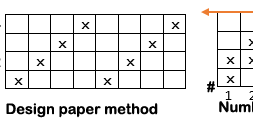
►The float extends from the base of one knitted or tucked loop to the next, and is notated by an empty square.
►The held loop extends into the courses above until a knitted loop is indicated in that wale.
►A single float stitch has the appearance of a U-shape on the reverse of the stitch.
►Float stitch fabrics are narrower than equivalent all-knit fabrics.
►As the wales are drawn closer together by the floats, thus reducing width-wise elasticity and improving fabric stability.
►The maximum number of successive floats on one needle is four.
►Six adjacent needles are usually the maximum number for a continuous float.
►A floating thread is useful for hiding an unwanted colored yarn behind the face loop of a selected color.
►The miss stitch can occur accidentally as a fault due to incorrectly set yarn feeders.
Float Stitch Formation Process
Effect of float stitches
►Float stitches make the fabric thinner than the tuck stitched one, as there is no yarn accumulation.
►It makes the fabric narrower as there is no looped configuration and hence the whole structure is pulled to minimum width.
►Less extensible than either knitted or tucked structure.
►Fabric is lighter in weight due to minimum yarn used in construction.
►Fabric is flimsy and less rigid compared to others.
(2289)
Emdad Sarker
Latest posts by Emdad Sarker (see all)
- Knitting Faults in fabric - November 17, 2017
- Basic weft Knitting Loops - March 26, 2016
- Float Stitch and it’s Formation Process - March 25, 2016